What if… We Could Train Truckers Like We Train Mice?
Have you ever been driving down the highway, moved to the left lane to get around a slower car, and suddenly, BAM! It ain’t happening. There’s a truck in the way. And he ain’t budging.
You flash your headlights and… Nothing. No effort to move over so you (and the cars that are now piling up behind you) can get by. You can see a half mile or more of completely clear freeway in front of this guy, but you can’t get to it.
Sunday night I was dreaming about mice… and a trucker who’d blocked me earlier in the day.
If you put a mouse in a maze, he’ll wind his way through until he finds the cheese at the end. The first time he doesn’t even know the cheese is there, but by the second or third time he’s learned a bit, and he works hard to get it as quickly as possible.
He continues to learn with each attempt. He learns which paths are dead-ends that slow him down and begins to avoid them. Interestingly, if, on the last straightaway, just in front of the cheese, you put an electrical shock, he’ll remember it, and find an alternative route. Even though he can see the cheese sitting there, and can’t see the electricity, he remembers the shock, and goes around to the back. Smart little critters.
What if, I dreamed… We legislate that every trucker have an electrode in their seat, with universal remotes for them sold at local Target stores? If a trucker doesn’t move over after you flash your headlights, you press the ‘Mild Reminder’ button, and ‘zzzt’, he gets a slight bit of excitement.
Still hasn’t moved over? You can opt for the ‘Moderate Persuasion’ button. This one was fun because I could see him in his rear-view mirror. He jumped a little. Oh the temptation…
Thus endeth the buttons on the remote. But not my dream. If you’re geeky enough to know what Virtual Easter Eggs are, then you’ll have already googled your third alternative. While holding down the power button on your remote, press the ‘Mild Reminder’ twice, and then press ‘Moderate Persuasion’ once. You’ll likely see the truck swerve right and left a bit, but he’s gotten the message, and he doesn’t want to find out if there’s a fourth option.
This could work even if you’re driving a Smart, Mini-Cooper, or Harley. Talk about power to the little guy!
Alas, even my dreams must eventually lean a bit more Libertarian (as enjoyable as the thought of those very un-Libertarian electrodes was).
What if… Every time a trucker needlessly blocked someone, the blocked driver eventually made their way safely in front of the trucker and slowed his left lane blocking self down a bit? Just enough to cause him to have to downshift four or five gears and then upshift back through those same gears to get back up to speed. Would this be enough of a PITA for him to eventually learn that blocking the left lane can be a bit of a dead-end?
If only this weren’t a dream.
After I woke up I thought about my dreams.
What if…, thought I, we didn’t have to treat truckers like mice?
——
Prologue: Since my dream, that every time I see a truck, I imagine a mouse driving it. Hah!
Almost Legal
Election day is always exciting for me, even when my candidates or ballot measures lose. It’s democracy in action like nowhere else on earth. Even though I very strongly disagree with his policy positions, it was still kind of exciting to see Barrack Obama elected in 2008 – we elected our first black president and we saw the power of citizens.
—–
California’s Prop 19, to fully legalize marijuana, didn’t pass. Latest results have it at 46.5% Yes to 53.6% No. Much of the news media are touting this as much more of a defeat than it really is though.
Think back perhaps 10 or 20 years. Would there have even been 20% support for such a measure? My guess is that pot will be decriminalized in California within 4 years. The war on it has simply proven too costly for too little benefit.
For the pro-legalization crowd there may even be a very substantial silver lining in this defeat. If this had passed it would have made California the only place in all of North America where pot could be legally purchased. Similar to what happened in The Netherlands, potheads would have flocked to California to experience smoking pot legally.
It’s one thing for the local populace to smoke it legally, it’s another to have an influx of potheads*.
There will very likely be several additional states joining California with legalization propositions on their ballots in 2012 and 2014. My guess is that California will still be the first, but a handful of others will follow two and four years later.
Just having a proposition like this on the ballot in all of these states will send a message to law enforcement and the judiciary that criminalizing pot is far from universally supported. Having 45% of the citizenry say so in an election sends an even stronger message. This, together with states legalizing medical marijuana, will ease enforcement efforts in these states, and thus, help reduce pot tourism to California.
* Potheads are generally not a problematic bunch. Just compare the crowds in a pot selling coffeeshop in Amsterdam to those in a bar, there or in the U.S. I’ll take the potheads any day.
Amsterdam is, even with their high pot and prostitution tourism, mostly U.S. folk, united in saying that they do not want to again criminalize these vices. They do not want the problems we have with prohibitions. However, as I discussed here, some of the border cities, such as Maastricht, are limiting sales to citizens only.
ObamaCare and Innovation
A couple of days ago I got to tour the 3M Innovation Center. The products this company makes are truly amazing, both in the technologies involved and in the sheer number of different products. The average person in the world (yes, the entire world) interacts with 31 different 3M products each day of their lives! Do you have a cell phone with a display? 3M product. You see over 21 roadsigns each day that use 3M reflection technology. EVERY semi truck trailer in the U.S. with those red/white blocks along the bottom is 3M technology. Your car uses 3M adhesives as do most planes in the air. If you have fillings, crowns, or braces in your mouth they are very likely made by 3M. If you watched the Chilean mine rescue you saw a number of 3M products from the face masks to the coatings on the Oakley sunglasses they were wearing.
Yes, this company goes way beyond post-it notes and Scotchguard.
For the computer geeks (others can skip this paragraph) who want to measure their overclocking in multiples instead of percents, there’s a new chip cooler using 3M’s Flourinert liquid*. They can produce this liquid with just about any boiling point so the cooler is much simpler, much less expensive, smaller, and does a better job of cooling than any existing liquid cooling solution. Basically there’s a liquid container bonded to the chip, a small radiator in the top of the case with a cooling fan, and one tube connecting the two. The Flourinert boils, vabor bubbles up the tube to the radiator, cools, and falls back down the same tube as liquid. They were running an Intel Core i7 980 at 13Ghz with this little rig. It was fun to watch how much the bubbles increased as the CPU worked harder and got hotter.
One product they’re hoping to have FDA approval for later this year is a new micro-needle technology. It’s basically a half-inch round transdermal patch with anywhere from 50 to 1,500 extremely tiny needles (try 50μm in diameter for small!). The needle tips are pre-coated during manufacturing with the vaccine or other medicine. When the patch is applied to your skin these microscopic needles go just below the surface to what is known as the stratum corneum**, the meds dissolve, are absorbed by your capillaries, and conveyed throughout your body.
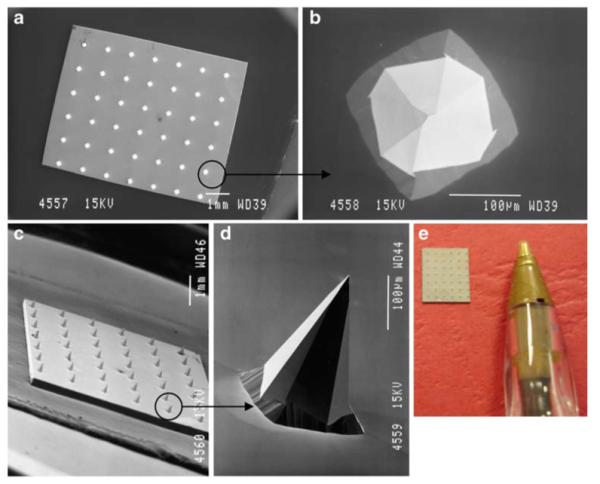 There are a number of benefits over syringes such as reduced chance of infections and other complications, higher efficacy (eg, more likely to get meds to where they need to go), and use of solid meds rather than liquid so they’ll last longer and not require refrigeration. Since micro-needles generally require less than 1/10th as much med, vaccine supplies cover about ten times as many people which will help eliminate problems such as we’ve recently seen with the scarcity of H1N1 vaccines.
This is all in addition to MUCH LESS PAIN for recipients. I hate getting shots. I’m very much looking forward to these things!
One really huge advantage to micro needles is cost savings. With a typical syringe injection only about 1/16th of the meds injected actually make it to your blood where it does any good, micro-needles deliver over 90%. This can reduce a $30 vaccine to $3. Because the solid meds are more stable and don’t require refrigeration there is also less waste (an estimated 15% of injectable meds are thrown out each year). And if they can be easily and safely self-administered there are potential savings in doctors office visits.
Now, let’s get down to brass tacks. 3M invested years and hundreds of millions of dollars developing this technology – for one reason – profits. They know, that if they are successful, privately run medical clinics will beat a path to their door. This product represents a lot of cost savings to the clinics as well as a benefit to attract new customers.
Without the profit potential, companies like 3M will not take the risks and make the investments to develop new technologies like this. Competition among medical clinics, drives competition in medical products, that drives 3M to do what it does.
If the U.S. medical care system were like the NIH in the UK, 3M and other companies would not invest in such risky new technologies. There is simply not enough of a payoff.
So, the next time you get a shot, think about it. They are injecting about 16 times as much med in you as needed. Overall this shot is costing about 10 times as much as it will when micro-needles are available. Under Obamacare there will be many fewer technology advances and products such as micro-needles will likely never be developed.
The more government involvement – the less competition. The less competition – the less innovation. And personally, I really like innovation that takes away real pain – like SHOTS!
* Flourinert has been around for about 40 years. It’s none electrical conducting so you can drop entire circuit boards in it. In fact one of it’s first uses was to help cool a Cray Supercomputer (and these always had clear plexi-glass side panels and bubblers in the bottom, purely for effect – very cool).
** Lightly scratch yourself with your fingernail. You may have reached as deep as the stratum corneum.
Happiness: Union vs. Non-Union
Are union bus mechanics happier than non-union?
Well, it turns out I’ve got a couple of friends who are bus mechanics to fill me in.
We have 7 bus companies serving our metro area. Two have union mechanics; our public government run transit system, and a private company. Five are private non-union shops.
One friend works for the public transit system. The other worked there for about 15 years but now works for one of the non-union shops. He’s been a bus mechanic for almost 3 decades and knows mechanics at all of the bus companies, thus knows of what he speaks.
Between these two I’ve developed what I think is a fairly accurate, though anecdotal, picture of things. Both are also in agreement on their assessments’. The upshot… Mechanics at the five non-union shops are much happier than those at either of the two union shops.
Mechanics in the union shops spend considerable time focused on, and complaining about, pay, benefits, and work rules. Those in the non-union shops rarely complain about these issues (or apparently any issues).
Mechanics in the union shops have an adversarial relationship with management, non-union mechanics have a friendly, common-good-for-the-company, relationship.
Mechanics in the non-union shops earn slightly lower base pay* (but better benefits) and yet are happier and work harder**.
Both said that working in a non-union shop is much more enjoyable – with happier fellow employees, friendly relationships with management, and a straightforward work environment not grunged up with union rules, meetings, and pressure.
—–
A similar comparison can possibly be made with airline flight attendants. I’ve long thought that Delta’s flight attendants seemed much happier and friendlier than Northwest’s. Guess which is union?
Based on discussions on AirlineCrew.net, Delta’s non-union FA’s make more money (overall and per hour) than their unionized NWA counterparts, but also lack union job protections such as work rules or the hours they can be required to work. It is also much easier to get fired by Delta than NWA though there is no indication that Delta is any more likely to fire FA’s than NWA. These discussions also reveal the happiness quotient – with Delta the clear winner. It’ll be interesting to see the outcome of their current unionization vote.
——
Money never makes us happy, but someone telling us that we should be unhappy certainly seems to work.
* Not including union dues that union mechanics are ‘required’ to pay. The non-union mechanic said that his company is also rolling out a profit sharing plan in 2011 that, based on past performance, will more than make up for any pay differences.
** The working harder (or smarter?) is anecdotal as well as statistical. Anecdotal based simply on their experience and, in the case of one of them, being told by fellow union members to work slower. Statistical in some very quick comparisons on how long certain jobs take with the union shop taking almost 50% longer for several common jobs than the non-union shops. Also, though there is little published data, union busses seem to generally be out of service for maintenance a greater part of every year. This could also be due to other factors such as age or harder use so more analysis would be necessary.
Sanctified Darkness ?
Interesting discussion at a church recently. They had rented a large front projection screen (22’ x34’) for a production and were given the option of purchasing it fairly cheaply.
The idea of keeping it permanently as a backdrop on their stage/platform and projecting on to it during worship was very appealing. One potential drawback however was that in order for any projections on it to be seen they’d need to very significantly lower the stage lighting level, otherwise the lighting would wash out any projected images.
Turned out there was no drawback to this at all. Just 2 benefits they thought of.
Benefit the first. Having the worship band nearly dark takes everyone’s attention off of the band and puts it on worship – where it belongs. Even the band members said that this has improved their own worship since they feel less like performers on a stage.
Benefit the second. Takes guys minds off the gals. Several years ago in a couple of surveys of Christian men I asked how often they were distracted by attractive women on stage, such as singers, and how often they had mentally undressed them. If I remember correctly 81% said that they had been distracted ‘often’ and 64% said that they had mentally undressed a woman on stage ‘multiple times per month’.
After determining that there were only benefits to the screen and lower lighting level they purchased the screen and have been using it successfully for some time now.
I wish I had surveyed this church prior to this change and could do it again now to see how it looks statistically. Anecdotally though, from a few brief conversations, it’s worked terrifically on both benefits.
American Toughs
For exercise I ride my bike. The two wheels with pedals variety. My knees won’t let me play football or run anymore so cycling (and skiing in the winter) is my primary exercise. And it’s a very enjoyable one. I ride about 140 miles per week and average 19 – 21 mph*. Not bad for an old guy.
I also wear the funny tight black shorts and pro team jersey that are, for better or worse, a practical necessity. The need for the shorts is rather obvious. There are three reasons for the jersey; a loose jersey flapping in the wind not only becomes an annoyance, but actually irritates my skin after a while, I need the lower back pockets for mid-ride food and sometimes an extra water bottle, and the sharp lines, letters, and bright contrasting colors of the pro-team jerseys are much more prominent to drivers than solid color, striped, or similar jerseys**.
Maybe 3 or 4 times a year someone will yell some snide comment out their window along the lines of “you look like such a dink in that outfit.” Well, duh. Like I don’t already know that. Do they think I have no fashion sense at all?
It’s interesting to me who makes these comments. It’s always some large ‘tough’ guy, usually driving a large pickup or SUV. Most are in their 30’s or 40’s.
I usually just ignore them, but a handful of times I’ve looked at them quizzically and asked “and your point?” which always leaves them sputtering for a bit while they try to figure out what their point is. On two occasions I’ve been invited to pull over so they can “show me their point by beating my face in.” “And that will prove what?” shut one up. The other required me to add “that you can beat up an old skinny guy?”***
We may have learned everything we needed in kindergarten, but apparently some people think they’re still there.
So, what is their point? Why do they feel the need to say something? Do they think that they’re helping me in some way? Does it make them feel better?
A couple of psychologist friends told me that comments like these are rooted in these guys having some kind of inferiority complex. Really? Because I have a nicer bike than they do? My cycling jersey looks better than their Brett Favre jersey? They’re jealous of my new svelte figure? Problems in bed so they’re taking it out on me?
How come women never make comments like this? Or people driving Lexus’s, Porsche’s, or Mercedes?
Not all big ‘tough’ guys driving trucks are this mature. Most people driving pickups are actually quite courteous and always move over a ways when they pass. Many will even wave me through at intersections so that I don’t have to stop (a royal PITA with clip-in pedals).
I have a number of friends who look the part of the guys who have the inferiority complexes. They’re rather big, pot-bellied, maybe a bit Neanderthal looking (and proud of it), and drive pickups. They’re also among the nicest people I know. They’re mostly trades workers who are quick to offer their skill, muscle, and expertise. And these guys have no inferiority complex. Nor any reason to have one. A couple have even taken up cycling. Lycra shorts and all.
BTW, though I’m skinny now, I still drive a big, decade old, V-8, SUV.
* For the exercise types reading this; I’m currently riding a Scott Addict with HED Ardennes wheels and a Garmin 705. I typically ride about 25 – 40 mile loops 3 to 5 days per week and average between 190 and 203 watts with a peak this summer of 880 watts in a sprint. My average heartrate for these is 152 and I usually see a max of around 175 on each ride. My highest heartrate this year was 182.
** Being seen by drivers is extremely high on my survival list and experimentation with a number of jersey’s has indicated that the pro team jersey’s appear much more visible based on the number of cars that pass way too close in different jersey’s. Even within the pro team jersey’s we’ve found that the ‘Saxo Bank Swiss’ and ‘Aqua Sappone’ jersey’s are the best. A psychologist friend told me that the large lettering itself actually probably helps a lot since it triggers thought processes in the drivers brain whereas solid colors, stripes, and other designs do not.
*** I’m not very thrilled with the old part, but I’m quite proud of the skinny part. I used to be more like these guys. It took considerable discipline to change my diet and exercise to lose the weight and keep it off.
Unions are so beneficial.
I have an interesting friend. His grandfather ran what is today a Fortune 100 company. His father was very successful as well. My friend went to university for business and accounting and was himself fairly successful in his business endeavors. In his late 30’s he tired of the corporate world and went to work for a non-profit that ran a number of organizations including homeless shelters, facilities and programs for underprivileged youth, and a very successful program to help single mothers obtain life and job skills.
He’s always loved engines and working on cars and trucks though. A couple of years ago he decided to take a well deserved break from the non-profit and find a job as a truck mechanic. He enrolled in a local tech school to get his mechanics certificate and began his job search. Now you have to imagine this. A 50-something guy with a masters degree and 3 decades of successful experience in upper management schlepping around trying to find a job as a truck mechanic. One other thing, he owns homes, very nice ones, in Arizona, Florida, Colorado, Wisconsin, Switzerland, and London. He wasn’t looking because he needs the money.
As an entry to becoming a bus mechanic he drove busses for a short bit. A few days ago though, he celebrated one year as a bus mechanic. And he’s happier than ever, especially when he solves some strange problem on one of their hybrid busses.
HOWEVER, that’s all background.
He works in a union shop. Where once he represented his company in union contract negotiations, today he’s himself a union member. This has given him a very interesting perspective.
His first real encounter was when other mechanics would tell him to slow down and not work so fast. That’s not in his repertoire. His boss was soon assigning him three busses per night while others, all senior to him, got one. He couldn’t have been happier.
He and I have both worked as mechanics in non-union shops and he now has experience in two union shops. He said that there’s a clear difference. The non-union folks, though all are working because they need the money, enjoy what they’re doing. They enjoy solving problems or making a car or truck run better. They’re happy that they can have a job doing something that they enjoy. Across the board though the union mechanics have replaced that enjoyment with angst. Their world is ‘us against the company.’
Similarly, the union guys have lost all sense of accomplishment. After 3 years they reach seniority. There’s nothing to attain nor nothing at risk. Their jobs are ‘union protected’ so they would have to try hard to get fired. And, no matter how hard they work, they’ll gain nothing more. Fixing one bus per night or three makes no difference to them so why work three times as hard? They come, they do their mediocre thing, they go home. And never go home with any sense of having accomplished anything.
When I worked as a mechanic I started on ‘straight time’ which meant I was paid an hourly wage, just like the union guys, and did what I was told. The difference is that I could be fired, and didn’t want to be, and I wanted to impress the boss so that I could start working ‘flat rate’ Flat rate is when you’re paid per job. For instance, replacing a water pump on a 1972 Volvo was rated as 45 minutes. Replacing a cylinder head was 3:15 (three hours, fifteen minutes). I think my rate was $20 per hour so I’d get $15 for the water pump and $65 for the cylinder head, regardless of how long it took me.
My first water pump took about 2 hours – not very profitable. After a few months though I was doing most jobs pretty close to time and soon I was coming in a bit under.
Screwing up wasn’t a good option. If I didn’t do a water pump correctly, I had to fix it, for no additional pay. I was far more careful after my first such experience.
Also, while I was paid $20/hour, my employer actually charged my time out at about $40/hour. This covered costs for the building, utilities, and stuff. More importantly, it was where profit came from. The more money I made, the more my employer made. Mechanics not billing enough time (or who screwed up and made customers unhappy) weren’t making money for our employer and didn’t keep their jobs very long.
My pay was a very direct reflection on how well I did my job. I was incented to work well and work hard. Most days I went home with a great sense of accomplishment, either because I’d made a bit extra money from working harder, or had solved some strange problem, or both. Every employee also shared in the profits (and we were very profitable) so every 3 months we’d get a profit sharing bonus. Every one of us made sure to keep our customers happy and coming back.
Back to the union guys. They work for a company that is subsidized by taxpayers – you and I. The fares they charge only cover about 30% of their expenses. Think about my friend who repairs three buses in the time the other 14 mechanics repair one each. Might it cost us taxpayers less to run this bus system if all of the mechanics did three buses per night? The savings wouldn’t be just that they’d need one-third the personnel (and one-third the benefits AND one-third the pension expense), but they’d only need one-third the facilities, utilities, training, insurance, and other costs of running the maintenance operation.
Interestingly this isn’t our only bus system. We have six other bus companies, all privately owned, serving the same area. All six have nicer and cleaner buses than our public bus system. Three charge the same fare and yet run profitable enterprises. The other three charge higher fares but also provide a much higher level of service. Guess what? None of their mechanics (or other employees) are union. Their mechanics also earn more money than the union mechanics and based on anecdotal experience, are much happier.
Hmmm….
BTW, I’m generally a supporter of public transport.
Proud Papa
It’s been a busy and hectic and amazingly awesome few weeks. My son got married.
I got to realize the dream of every father. To be able to look at my son and feel extremely and hugely proud of the man he’s become.
He’s doing well at university, has been elected head of his university’s broadcast arm, and has a good job offer for after he graduates next spring.
But that’s all just surface (though still very wonderful!)
He persuaded a terrific Christian woman to marry him. Knowing and seeing the love that he has for her makes me proud. That may seem like a strange thing to be proud of, but I am very proud of that in him. His love for her is not a selfish love. It’s a love for who she is and for her love of God. It’s a love that prefers her over himself. It’s the love that Paul talks about when he says that Christ loves us as a husband loves his wife.
Now we’re getting below the surface.
Almost any dolt can find someone to marry them. My new daughter isn’t just someone. That she choose to marry my son (and that her parents agreed) says a lot about him. And it’s the qualities that she sees in him and that I’ve seen develop in him throughout his life that has me bursting.
His Leadership – This is something that extremely few posses, that I don’t think is important for everyone to develop, and that I didn’t necessarily expect in him nor would have been disappointed had he not developed these. Leadership is a rather strange beast. There is often a fine line between leading and serving. A good leader does both and knows when each is needed. He’s learning these (and will continue to throughout his life) along with when direction is critical and when to leave people to do their own thing and contribute in their way. He’s learning what goofs are important to deal with and which to let slide. He’s learning what attributes are most important in people you hire (like character and integrity!).
His Family Leadership – OK, I sort of lied when I said that leadership isn’t important for everyone. Leadership in the home is important for all husbands and fathers. And wives and mothers. Like public leadership, it’s a balancing act of leading and serving, of knowing what’s important to deal with and what’s not. It’s accepting our own failures as the imperfect people we are and knowing what to realistically expect of others. And most important, looking to God to guide us as we guide our families. Seeing him develop in to the husband that God wants him to be is truly joyful.
His Character – A big huge bundle of really important stuff! He has a strong work ethic. He’s compassionate and caring. He has a good sense of humor (and is learning to laugh at his own humanness – like referring to his new wife as his husband in a toast at his reception). He’s developing a good sense of when to be serious and when it’s not so important. He’s learning more and more to appreciate and respect the good in others, to not judge others, but also to choose his friends and close associates carefully. He’s always been fairly even keeled, but he’s gaining a better realization that on the other side of every valley is a hill or mountain (and that hills and mountains don’t last forever) and that eventually there is light at the end of every tunnel and that over time things work out and that a positive attitude goes a long way towards overall happiness.
His Integrity – Truthfulness and honesty and accuracy are important to him. As they should be to all of us. ‘nuff said.
His Faith – Above all else, he is continually deepening his relationship with Christ. Just like all of us he still occasionally has his struggles and doubts, but he’s learning to take these in stride.
So I get to bask for a bit in being a very proud papa. For the man my son has become and for my new daughter – the woman he chose and who agreed to marry him.
Death of Internal Combustion Engines ?
This morning I heard an interview on the radio with an executive of Ford Motor Co. Interestingly, the bulk of the interview turned in to him defending the internal combustion engine. At least 3 times he said “it’s not dead yet, it has a lot of life left in it.” Well, it certainly has some, but based on this interview, “a lot” might be a stretch. Nissan won’t be able to make Leaf’s fast enough to meet demand for at least 3 years. There appears similar clambering for Mercedes’ electric Smart, Tesla’s S, Mitsubishi’s MiEV, and electric vehicles announced from BMW, Porsche, Toyota, and others. Even Chevy is seeing demand for it’s Volt.
It’ll be interesting to see what percent of new cars sold in 10 years are internal combustion vs electric.
Benevolent Drug Dealer
This morning I talked with a benevolent drug dealer. Lest you think this is a play on words, it’s not. We’re talking genuine drug dealer here. He sells pot, hash, cocaine, crack, and a small variety of other substances.
Benevolent? You betcha.
His goal is to either get his customers off drugs or at least get them using responsibly.
And he’s having pretty good success. On the latter one anyway. In the past year he said that 12 of his customers have gone from irresponsible, jobless, heavy drug users, to something much better. 3 have stopped drug use altogether and 9 have quit everything but pot which they smoke only moderately (though he said in a couple of cases moderate is in the eyes of the smoker.)
All of them have begun taking more responsibility for their lives. 10 have had jobs, 8 are currently employed, and every one who’s unemployed is looking. 4 of them have started taking responsibility for their children, 3 for the first time since they were born.
He said every single one of them is focused on improving their lives and that of their families.
But why a drug dealer?
“Not more than one or two of these would ever have even talked or listened to anyone from any kind of organization. They talk and listen to me.”
He started by selling his dope for slightly less than other dealers. Today, partly due to pressure from who he gets his stuff from, he sells for about the same as others. He has a steady supply of customers though, probably about 40 regulars. “I’m not worried about losing customers, for every one that I get to cut their use, 2 more come.”
He doesn’t push redemption on anyone. If someone becomes a regular customer he’ll let them know that there are options that he can help them with. From there it’s up to them to ask him for help. Well, sort of.
Similar to how my wife weaned me off of whole milk by suddenly buying only 2%, then 1%, and finally skim, he very slowly weans some of his customers off of heavy use. “It only works for about half though.” He says fairly unemotionally. He’s not underhanded about it, he just tells them that he thinks their use is getting out of control and that he doesn’t want to lose them as a customer so how about buying and using just a little less.
“If I wasn’t here they’d all be buying from someone else so I’m not increasing drug use any. And I’ve helped a couple of dozen folks who probably wouldn’t have been helped otherwise.”
Let’s not fool ourselves though. I don’t think many of the folks he’s helped are people most of us would want around our kids. They haven’t become angels and I doubt most of them would even be candidates for Curtis Sliwa’s Guardian Angels. But they’re all doing much better than they were before. They’re less likely to commit any real crimes (as opposed to personal vice), they’re productive instead of welfare expenses, and it sounds like, as imperfect as they are, that some are becoming parents to their children which means that their kids will be less likely to become social problems.
This isn’t a perfect solution and certainly not as successful as our drug war that’s so effective in keeping drugs off our streets in the first place.